
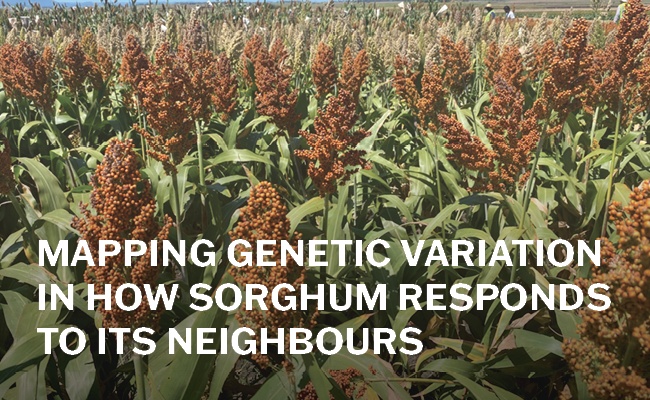
Sorghum farmers in drier regions face a subtle problem. When water is limited, the standard approach is to space plants further apart, so each one has more soil moisture. The difficulty is that sorghum plants with extra space respond by producing more shoot branches, known as tillers. Those extra tillers use water early in the season, before grain filling, and the water saved by wider spacing is spent on branches that may never pay it back, ultimately lowering grain yield. Not every sorghum variety responds this way to the same degree.
How does a sorghum plant know whether it has neighbours? One of the cues is light quality. Plants carry photoreceptors called phytochromes, which absorb red light (around 660 nm) from sunlight for photosynthesis, while far-red light (around 730 nm) is reflected back into the surrounding environment. A neighbouring plant’s phytochromes detect that reflected far-red as a shift in the red-to-far-red ratio. When neighbours are close, the ratio shifts towards far-red, and the plant responds by producing fewer tillers. The sensing side of this is well understood. What varies between sorghum varieties is how strongly they act on it.
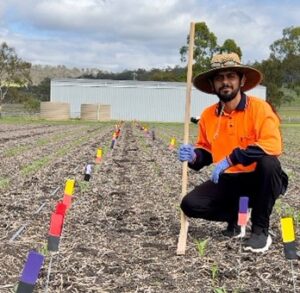
To quantify how strongly each variety responds to its neighbours, we grew a diversity panel of ~900 sorghum lines covering the major racial diversity groups within the cultivated gene-pool. The trial ran over two seasons (2023 and 2024) at the Hermitage Research Facility in Warwick, with plant spacings ranging from 5 to 60 cm. Rather than analysing density as a categorical treatment, we measured the actual distance from every focal plant to its nearest and farthest neighbours after emergence and establishment. This let us treat neighbour proximity as a continuous variable and capture how each plant’s response scales with the distance to its real neighbours, rather than the spacing it was nominally sown at. A separate set of focal plants was left in isolation by removing any neighbours within 60 cm, the distance beyond which it is known that the neighbour effect disappears. We then fitted a non-linear mixed model to the tiller counts using the nearest and farthest neighbour distances and their interaction. The model returned a responsiveness coefficient for each genotype. Two genome-wide association studies were run on 750,000 SNPs from whole-genome resequencing: one on tiller number in isolated plants, and one on the responsiveness coefficients.
Sorghum varieties differed markedly in how strongly they responded to their neighbours (Figure 1). Some produced fewer tillers as neighbours closed in; others barely changed. The isolated-plant GWAS returned 52 QTL for basic tillering capacity. The responsiveness GWAS returned 50 QTL for how strongly each variety responded to neighbour proximity. 10 QTL regions overlapped between the two sets, which fits the biology that a plant shaded by its own leaves uses the same phytochrome machinery as one shaded by its neighbour. To test whether the responsiveness signal was genuinely light-driven, we checked our QTL against 14 red/far-red signalling genes already characterised in model species. Three of the fourteen were within the responsiveness QTL. None were in the basic-tillering QTL.

Figure 1. Sorghum genotypes vary in how strongly they respond to their neighbours. Each point is one variety’s average tiller number when grown in isolation (x-axis) versus when grown at high density (y-axis). The dashed line marks where a genotype would sit if neighbours had no effect. Points below the line are the responsive varieties, they produced fewer tillers when neighbours were present. (Data from 2023).
In managed cropping systems, responsiveness to neighbours can work against a grower as easily as for them. A farmer who widens rows to save water needs a sorghum variety that holds its architecture, not one that spends the saved water on extra tillers. Given the polygenic control we found, genomic prediction is a more likely route forward than single-gene selection. Being able to map responsiveness means breeders can now select for it, or against it, as the system requires.
PhD Student, The University of Queensland


