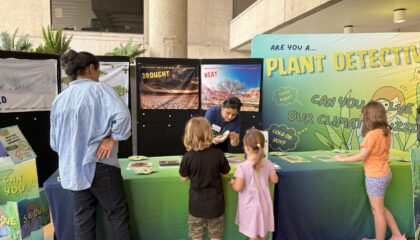
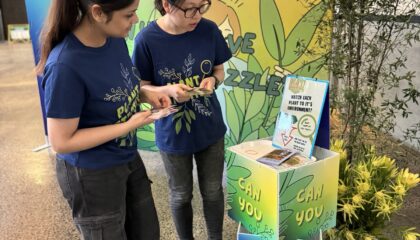
The Centre of Excellence for Plant Success is committed to developing resources and facilitating outreach opportunities for primary and secondary school students and the public.

School Outreach

Our Centre members frequently participate in school outreach initiatives including the National Youth Science Forum, Wonder of Science, and CSIRO STEM Professionals in Schools just to name a few! If you would like us to run an activity for your school group, please contact outreach@plantsuccess.org.

TEACHING RESOURCES

The Centre has created a series of free teaching resources that align with Version 9.0 of the Australian School Curriculum.

Birds or Bees

Birds or Bees is a four-lesson suite of activities for Year 5 students aligned to Australian Curriculum V9 (AC9S5U01). The series progressively develops students' understanding of pollination, pollinators, plant reproduction, and the importance of these processes for ecosystems and food production. The lessons combine scientific knowledge with creative, collaborative, and inquiry-based learning experiences.
 

Lesson 1: What is Pollination?

  • Introduction to pollination and common pollinators.
  • The importance of pollination for plant survival and food production.
  • The potential consequences of losing pollinators.

Access Presentation Slides for Lesson 1 >

Access Teacher Resource for Lesson 1 >

Lesson 2: Types of Pollinators

  • What pollinators are and how they assist plants.
  • Characteristics and behaviours of different pollinators.
  • How flowers attract specific pollinators.

Access Presentation Slides for Lesson 2 >

Access Teacher Resource for Lesson 2 >

Lesson 3: How Pollination Helps Plants Survive

  • Flower structures.
  • Seed formation and germination.
  • The role of pollination in food production and ecosystem health.

Access Presentation Slides for Lesson 3 >

Access Teacher Resource for Lesson 3 >

Lesson 4: Pollination in Action!

  • Identification and investigation of flower parts.
  • Reflection on the consequences of pollinator decline.
  • Pollinator behaviour and movement patterns.

Access Presentation Slides for Lesson 4 >

Access Teacher Resource for Lesson 4 >

Friend or Foe

Friend or Foe is designed to help students understand that plants interact with living things in their environment, particularly microorganisms in the soil, and how these interactions support plant survival and growth. The content aligns with Year 5 Biological Sciences in the Australian Curriculum V9 (AC9S5U01).

Access Teacher Resource for Friend or Foe >

Lesson 1: Introduction to symbiosis

  • Mutualism, parasitism and commensalism.

Access Presentation Slides for Lesson 1 >

Access card game for Lesson 1 >

Lesson 2: Plant symbiosis

  • Explore how microbes live around plant roots and learn that some microbes are beneficial while others cause disease.

Access Presentation Slides for Lesson 2 >

Lesson 3: Plant friends - Mycorrhizal fungi and Rhizobia

  • Mycorrhizal fungi - help plants absorb water and nutrients.
  • Rhizobia bacteria - help legumes obtain usable nitrogen through root nodules.

Access Presentation Slides for Lesson 3 >

Lesson 4: How plants distinguish friends from foes

  • Learn how plants can distinguish between beneficial microbes and pathogens through their immune systems and chemical signalling.

Access Presentation Slides for Lesson 4 >

Up or Down

Through a plant detective mystery, students learn about gravitropism (how plants respond to gravity). The content aligns with Year 5 Biological Sciences (AC9S5U01) and Year 6 Science Inquiry (AC9S6I01) in the Australian Curriculum V9. There are four activities outlined in the document:

Activity 1: The Sideways Challenge

Students investigate how plants respond to gravity by placing a potted seedling on its side and observing it over several days.
 

Activity 2: Root Maze Engineering

Students create a clear observation chamber containing germinating seeds and a maze of obstacles. As roots grow, students observe how they navigate around obstacles.

Activity 3: Quiz

Students participate in a quiz to review and reinforce concepts from the lesson.
 
Activity 4: Seed Jar Challenge (at-home activity)
Students create a seed germination jar using bean seeds, paper towels, and a clear jar. Over 2–4 weeks, they observe and record the stages of germination, paying particular attention to the fact that roots grow downward and shoots grow upward regardless of seed orientation.

Access Presentation Slides >

Access Teacher Resource >

Thrive or Die

Learn about some of the adaptations plants have evolved to survive in different environments by combining science inquiry with creative art. The content aligns with Year 8 Biological Sciences, Science Inquiry and Visual Art in the Australian Curriculum V9 (AC9S8U02; AC9S8I01; AC9AVA8C02).

Access Presentation Slides for Thrive or Die activities >

Access Glossary for Thrive or Die activities >

Activity 1: Plant traits

Students learn about plant traits then discuss which of these traits might make plants more tolerant or less tolerant to heat, cold, drought and flood.

Access worksheets for Activity 1 >

Access Teacher Resource for Activity 1 >

Activity 2: Matching game

Match each plant trait to its environment.

Access worksheet for Activity 2 >

Access Teacher Resource for Activity 2 >

Activity 3: Art session
Invent a plant species that is adapted to one of four environmental extremes - cold, heat, drought, flood. Learn about botanical naming conventions to come up with a name for the new plants.

Access worksheet for Activity 3 >

Access Teacher Resource for Activity 3 >

Activity 4: Classroom Exhibition
Display the new plant species in the classroom for fellow students to evaluate the traits that others came up with to help their plant thrive in its environment.

Access Teacher Resource for Activity 4 >

Tall or Short

Tall or Short explores the relationship between genetics, heredity, and cell division using plant height as a model trait. The content aligns with Year 10 Biological Sciences in the Australian Curriculum V9 (AC9S10U01).

Download Presentation Slides (PowerPoint file) >

There are two core activities and one extension activity as part of this lesson:

Activity 1: Dice Game

This activity simulates the random inheritance of alleles and compares experimental results with Punnett square predictions. Students roll allele-labelled dice to generate offspring genotypes (TT, Tt, tt) and observe probability in action.

Access dice handout >

Activity 2: Visualising Meiosis

Students use coloured pipe cleaners to represent maternal and paternal chromosomes to model how meiosis turns one cell into four sex cells, each with half the number of chromosomes.

Access Meiosis pipe cleaner activity instructions >

Extension Activity: Design Your Own Plant

Apply understanding of dominant and recessive alleles by designing a breeding strategy that guarantees offspring inherit a chosen trait. Students select genotypes, create Punnett squares, and justify their breeding decisions. Instructions for this activity are within the slides.

Nature or Nurture

Nature or Nurture is a three-lesson suite of activities for Year 10 students aligned to Australian Curriculum V9 (AC9S10H02). The activities introduce students to gene editing with CRISPR-Cas9, build understanding of how genetic changes affect traits, and then explores the ethical and societal implications of biotechnology in Australia. Lessons take approximately 45 minutes to deliver and can either be used as standalone activities or delivered in any order. A quick reference guide has also been created to support teachers with general CRISPR knowledge >

Lesson 1: CRISPR Quest

  • Structure and function of DNA.
  • General introduction to CRISPR technology.
  • A DNA editing activity.

Access Presentation Slides for Lesson 1 >

Access Teacher Resource for Lesson 1 >

Lesson 2: CRISPR Detective

  • An activity to explore real-world applications of CRISPR in plant science and agriculture.

Access Presentation Slides for Lesson 2 >

Access Teacher Resource for Lesson 2 >

Lesson 3: CRISPR Council

  • An activity to develop students' critical thinking and ethical reasoning by evaluating the benefits, risks and governance of CRISPR technologies in Australia

Access Presentation Slides for Lesson 3 >

Access Teacher Resource for Lesson 3 >

Pass The Plant

Pass The Plant features three activities that encourage students to explore and communicate their knowledge about plants at three different learning levels. The two videos linked below accompany this activity.

  • Activity 1 - Foundation/Kindergarten (AC9SFU01): Students collect a plant item from the school grounds and participate in a “pass the parcel” game, sharing observations about the item's features and purpose.
  • Activity 2 - Years 4–6 (AC9S4I06; AC9S5I06; AC9S6I06): In groups, students research an interesting plant fact and create a short “Pass the Plant” video, asking and answering questions about their chosen fact.
  • Activity 3 - Year 8 (AC9S8U01): Students work in groups to research plant and animal cells, then produce a video explaining key similarities and differences using creative transitions and digital media skills.

Access Resource >

Cool Jobs

A series of videos that open a window into the exciting world of plant science careers - from breeding stronger crops to uncovering the secrets of plant genetics and even using maths to solve big challenges in agriculture. You’ll hear from PhD students, postdocs, and professors as they share their journeys, discoveries, and the many ways plant science is shaping a sustainable future.

Bonus Activities

Below you will find some bonus activities that can be used by teachers to help students learn more about plants.

Human or Plant - transport systems

This activity is a sorting and discussion exercise that helps students compare the transport systems of humans and plants. Students are given a list of words (such as arteries, veins, xylem, water-based, and grafting) and must decide whether each relates to humans, plants, or both. They work together to place the terms into the correct category, then explain and justify their choices.

Access handout >

Access answer sheet >

Human or Plant - structures

This activity is a sorting and discussion exercise that helps students compare the protective and exchange structures of humans and plants. Students are given a list of words (such as hair, pores, stomata, cuticle, and gas exchange) and must decide whether each relates to humans, plants, or both. They work together to place the terms into the correct category, then explain and justify their choices.

Access handout >

Access answer sheet >

National Science Quiz

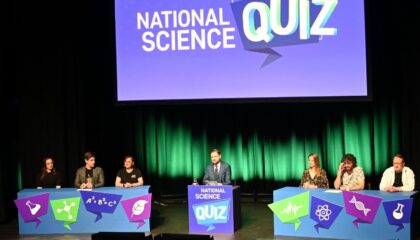
The Centre has been proud supporters of the National Science Quiz in 2022 and 2024 and we were thrilled to convene the Quiz in 2023. Inspired by the popular De Nationale Wetenschapsquiz in The Netherlands, Australiaʼs National Science Quiz covers all areas of science with approximately 40 thought-provoking questions to test your knowledge and skills.

TOP