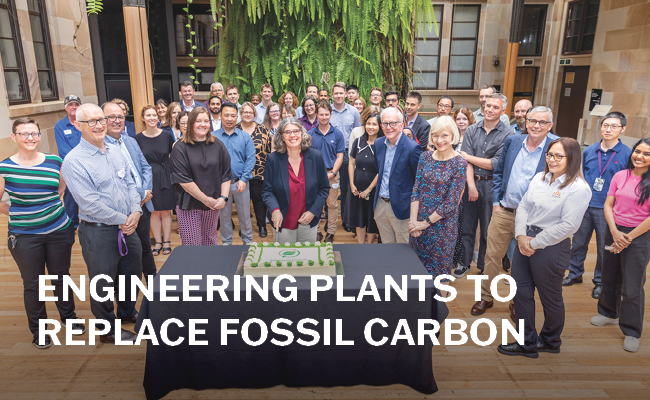
 On November 10 we were thrilled to officially launch the ARC Research Hub for Engineering Plants to Replace Fossil Carbon (pictured above). As Director, I am pleased to have this opportunity to share an update with the Plant Success community about how our multidisciplinary team is taking a fresh approach to transforming plant waste into valuable carbon-based products such as jet fuel.
Much of the global investment in this space has already demonstrated that converting plant biomass into aviation biofuels and other bioproducts is both technically feasible and environmentally essential. However, the cost of sustainable aviation fuel remains two to three times higher than standard jet fuel, creating a major barrier to widespread adoption. If we want people and industries to choose the more environmentally desirable option, we need to ensure it is also cost-competitive.
Processing technologies for plant biomass are already well established. For that reason, the Hub is focusing on improving the inputs – that is, the plants themselves. By using new scientific capabilities to understand and modify the biosynthesis of plant cell walls, we aim to make biomass easier and more efficient to process.
Sugarcane offers a clear example of the challenge and potential ahead. Currently, only 20 to 25 per cent of the carbon in sugarcane bagasse can be converted into fuel. Our team aims to lift that to 50 per cent. Increasing the proportion of carbon that can be converted into a final product, whether a fuel or a biomaterial, is where we see the greatest opportunity for impact.
Our team includes many familiar faces to Plant Success including Robert Henry (inaugural Hub Director), David Jordan and Emma Mace, and we look forward to working further with the Centre on initiatives that will benefit plant science.
With our collective expertise and shared vision, the Hub is well positioned to drive meaningful progress toward sustainable, carbon-neutral alternatives that benefit both industry and the environment. I look forward to seeing the innovations that will emerge as we work together to shape a cleaner future.
Associate Professor Karine Chenu
Director of the ARC Research Hub for Engineering Plants to Replace Fossil Carbon
Plant Success Associate Investigator, The University of Queensland