
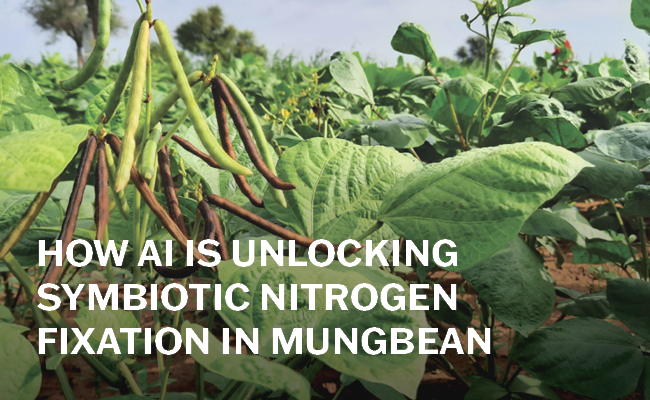
 Every gram of synthetic nitrogen fertiliser comes at a cost of energy, money, and carbon emissions. Over the past 50 years, this natural process has been overshadowed by industrial production and use of industrial fertilisers, which have become essential for food security but undermine environment and human health. There is a pressing need to explore more sustainable solutions that can meet the demands of a rapidly growing global population while minimising harm to the environment and human health. In this scenario, legumes offer a sustainable solution to food security without environmental harm.
Legumes contribute about 50 million tonnes of nitrogen, worth about $50 billion, to protein production and agricultural soils each year via symbiotic nitrogen fixation with bacteria called rhizobia. That’s the area that I am exploring in my PhD research. I am working on mungbean (Vigna radiata), an economically important summer pulse crop in Australia and across South and Southeast Asia. Like other legumes, it receives much of its Nitrogen for protein production and growth from symbiotic nitrogen fixation. There is a potential to increase the fraction of nitrogen that legumes obtain from the atmosphere versus the soil, via improvements in symbiotic nitrogen fixation. It is clear from previous studies that there is substantial natural variation in symbiotic nitrogen fixation effectiveness within plant species that could be harnessed via advanced plant breeding techniques. Understanding why and identifying the genetic variants responsible is the key to breeding mungbean varieties with improved symbiotic nitrogen fixation.
One of the most informative indicators of symbiotic nitrogen fixation is nodulation itself: how many nodules a plant has and how large they are. For a small glasshouse experiment, measuring nodulation is manageable but large-scale field trails that involve hundreds of plants pose a challenge. Counting and characterising nodules on hundreds of root systems by hand is not just tedious, it is a genuine scientific bottleneck. Manual scoring introduces subjectivity, fatigue-related errors, and limits the throughput needed for large-scale genetic studies. If we want to connect nodulation traits to the genome, we need a faster, more consistent way to measure them.
This is where artificial intelligence steps into my PhD. As part of my research, I am deploying a deep learning model for automated nodule phenotyping, a system trained on annotated root images that can detect, count, and characterise nodules with the speed and consistency that would be impossible by hand. Using convolutional neural networks and image segmentation techniques, the model learns to distinguish nodules from background root tissue and quantify their size distribution. AI driven high-throughput phenotyping transforms what was once a manual measurement into a scalable data pipeline. Combined with ¹⁵N isotope dilution assays which is the gold standard for quantifying actual nitrogen fixation rates, this approach gives us a rich, multi-layered picture of symbiotic nitrogen fixation performance across a diverse genetic population.
I hope this AI-counted nodule phenotype will be a useful phenotyping trait for plant breeders to link with symbiotic nitrogen fixation in future breeding programs. Currently, we are doing this only in mungbean, but it has the potential to be deployed in other legumes with some adjustments. It also opens the door to accelerating breeding programs, which is the current need for plant breeders, given the ever-increasing population and the challenges of climate change.
Last but not least, I believe AI could be our last mistake, but using it in the right direction is still the need of the hour.
Hamza Ramzan
Associate PhD Student, The University of Queensland


