
 Hey y’all,
This September, I had the privilege of attending the third Global Sorghum Conference in Lubbock, Texas, hosted by Texas Tech University in partnership with the Global Sorghum Association. The conference has become a genuine global fixture for the sorghum community, first held in South Africa in 2018, then France in 2023 and now the USA in 2026. This year, more than 375 attendees from 20 countries were brought together to exchange ideas, share research and strengthen connections across research, production and industry.
Why have a conference about sorghum?
Sorghum is a water-efficient crop with increasing applications across food and biofuel industries. This conference was a rare chance to get researchers, breeders, growers and industry from across the globe into the same room to catalyse discussion around the highest-priority topics. One message emerged repeatedly throughout the conference: discovery on its own is not enough. Our work only really matters once it’s in a bag of seed and out in a farmer’s field. Bridging the gap between trait discovery and deployment was a major focus, with many discussions centred on how research can be translated into real-world impact.
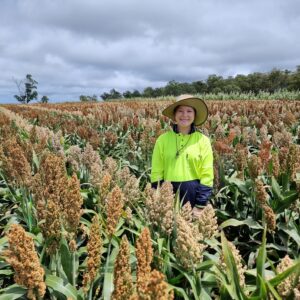
Sorghum’s future isn’t about being the cheapest grain, it’s about being the right grain. Plenary talks consistently highlighted sorghum’s superior water-use efficiency and nutritional profile compared to other crops. I was intrigued to learn more about the substantial innovation occurring simultaneously across food, feed and biofuel uses. A large downpour, the first meaningful rain the region has seen in weeks, reshuffled the field tour on the final day. The silver lining was a modified itinerary that included exposure to sorghum’s multiple end uses. A guided tour of a large-scale dairy operation highlighted sorghum’s use as silage, and a visit to the White Energy Ethanol facility explained how sorghum is being used to fuel millions of cars. This tour was wrapped up by a delicious American BBQ lunch and plenty of discussion on sorghum production and commercial uses, made all the more relevant by the region’s reliance on the depleting Ogallala Aquifer, which is pushing growers toward more efficient irrigation and water-conserving crops like sorghum.
Standout talks and people
The scientific program was full of highlights and the plenary and panel sessions were consistently diverse and insightful. I really enjoyed hearing Jessica Davidoff’s story, from her children’s serious corn allergy to building Cob Foods, a sorghum-based snack company backed by Novak Djokovic. I can attest that the corn-free popcorn samples tasted very similar to popcorn, just smaller and without the tough pericarp to get stuck in your teeth.
Maria Salas Fernandez showcased her research from Iowa State University about improving lodging resistance through understanding mechanical properties in forage and biofuel sorghum.
Harshita Mangal (University of Nebraska) presented an impressive innovation of high-throughput tissue collection for RNA-seq to link flowering time Genome-Wide Association Studies to Transcriptome-Wide Association Studies.
The breadth of the presentations reflected the diversity of challenges and opportunities facing sorghum research, from food innovation and crop improvement through advancing trait dissection.
Our Australian impact
Australian researchers were well represented throughout the program and made significant contributions across multiple sessions. From UQ, Emma Mace provided her trademark clear and animated update on our sorghum branching research, and Srinivasa Mothukuri presented both a poster and two talks on his lodging PhD work. Erik Van Oosterom hosted an enjoyable student 3-Minute Thesis (3MT) session and I gave an overview of our KickStart Centre-funded project and our results to date, which generated valuable discussions and new connections with researchers interested in the root microbiome.
Chief Investigator David Jordan celebrated a milestone birthday during the conference, which meant cake for all! The extra calories were required, David was busy with a keynote, workshop, giving multiple presentations on behalf of those who could not make it to the conference, performing his duties as the Global Sorghum Association Board Chair, while somehow still finding time to catch up with colleagues and form new connections.
From “what is sorghum?” to “how do I cook it?”
Some surprisingly delightful sorghum dishes were served throughout the conference. One evening, we were lucky enough to try a variety of sorghum-inspired dishes representing culinary traditions and flavours from around the world. If you’re curious, there is a great collection of recipes on the Sorghum Checkoff’s recipe page.
Texas, in a nutshell
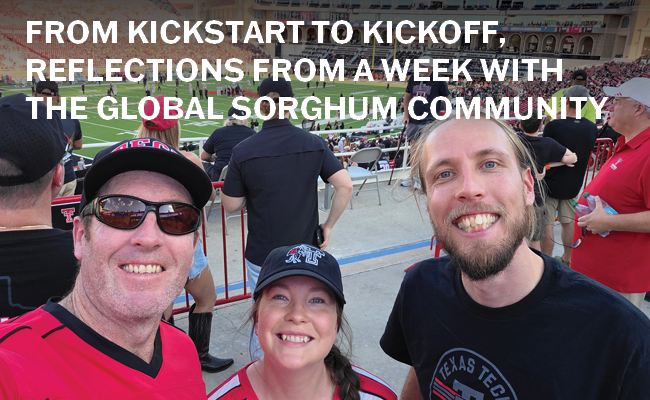
A few honest first impressions of Texas: armed guards at venue entrances, signs about concealed weapons, and meeting someone from the CIA (who turned out to be from the Culinary Institute of America rather than anything more dramatic). Despite the different culture, everyone we met was extremely warm and welcoming. Texans really do hospitality well. We made sure to immerse ourselves properly: cheering on the Texas Tech Red Raiders and being thoroughly entertained by the extravagant game-day atmosphere, attempting line dancing in our cowboy boots at the National Ranching Heritage Center, and sampling plenty of local cuisine.
Looking ahead to 2029
As a member of the local organising committee for the Global Sorghum Conference 2029, which will be held on the Gold Coast in February 2029, I spent a lot of this trip taking notes, not only on the science but also on what makes a conference of this scale successful, so we can bring some of those insights back home. Just as important as what I learned was who I met. I’m already looking forward to reconnecting with the wonderful people I met in Texas, and to meeting those I didn’t get the chance to this time, when we all gather again in 2029.
Finally, a big thank you to the Centre’s ECR Capacity Building Scheme for the support and funding that made this trip possible.
Sofie Pearson
Postdoctoral Researcher, The University of Queensland


