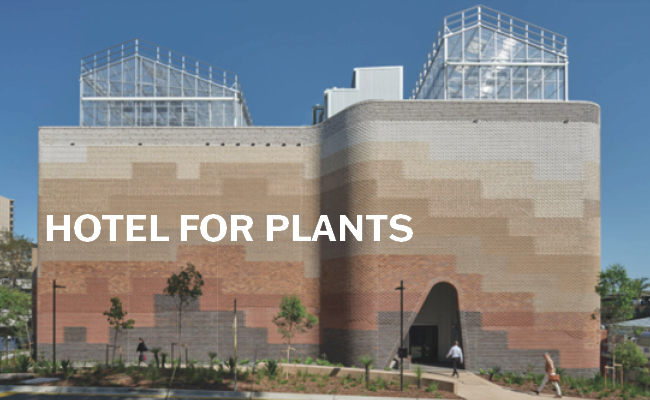

High-quality experiments conducted by the Centre for Plant Success require state-of-the-art facilities, such as the Plant Futures Facility (PFF) at The University of Queensland’s St Lucia campus. So, what is hidden behind that award-winning brick wall? And how can this facility support the Centre?
The PFF operates like a hotel for plants, although some users might rather consider it a candy store for plant scientists, considering it has opened numerous research possibilities that were previously not available at UQ. While the PFF is the flagship facility that is managed by the Plant Growth Collaborative Research Platform (CRP) at UQ, it is part of a pipeline of complementary facilities that together supports translational research from discovery to impact. Plant Growth also interacts closely with the UQ node of the Australian Plant Phenomics Network (APPN), which is an NCRIS capability. Their phenotyping capability complements the facilities managed by Plant Growth and together, they provide a comprehensive and expanding suite of research capabilities.
Inside the PFF are reach-in growth cabinets and walk-in growth rooms of various sizes and specifications to cater for a wide range of research applications. Specifically, there are rooms for research on the effects of high temperatures and light spectra on crop growth and development, rooms for entomological and pathological research, plus AA accredited quarantine rooms. The ability to uncouple environment parameters that are linked in nature allows users to study effects of individual environmental parameters on crop growth and development without confounding effects. For example, this enables research on the effects of daylength on crop growth and development while keeping total daily light integral constant, or research on crop responses to VPD at constant temperature.
On the flip side: one year of operation has also revealed some limitations to capabilities in the PFF. And that is one reason why Plant Growth includes an academic position in addition to the professional staff that maintain and operate the facilities. My role as Academic Lead is strategic and currently, this includes testing the limits of the capabilities of the PFF, identifying bottlenecks to research capacity and capability, and working with suppliers to explore solutions for some of these bottlenecks. For example, plant testing identified that sorghum is particularly responsive to variation in light spectra. As a result, some rooms are being retrofitted with additional far red light sources to address this issue. Arabidopsis turned out to be extremely sensitive to air velocities, but larger rooms with lower air velocities than smaller rooms were a saviour. Plant Growth has also tested the best modes of operation to achieve smooth transitions from night to day conditions.
Managing plant growth facilities is different from actively conducting research. But there are still numerous opportunities for me to connect to research and interact with users and students. Importantly, it provides an opportunity to use my knowledge to improve the facilities that we have and to pass on some of the crop physiological insights that I have gained to the next generation of academics and to staff in Plant Growth. That is important, as that will enable Plant Growth staff to better work with users, and not just work for them. After one year of operating new facilities, I have convinced myself that I can make enough of a difference to enough people to have made the switch from research to Plant Growth worthwhile.
If anybody wants to use Plant Growth facilities and wants to discuss their planned experiments, please reach out to our group. The facilities we manage are only as good as the cutting-edge research that happens inside. And with Plant Growth being part of the PVC-RI portfolio, equal access to anybody in the Centre, no matter what organisational unit you belong to, is ensured.
Erik van Oosterom
Centre Research Fellow and Academic Lead, Plant Growth – Collaborative Research Platform (CRP), The University of Queensland