
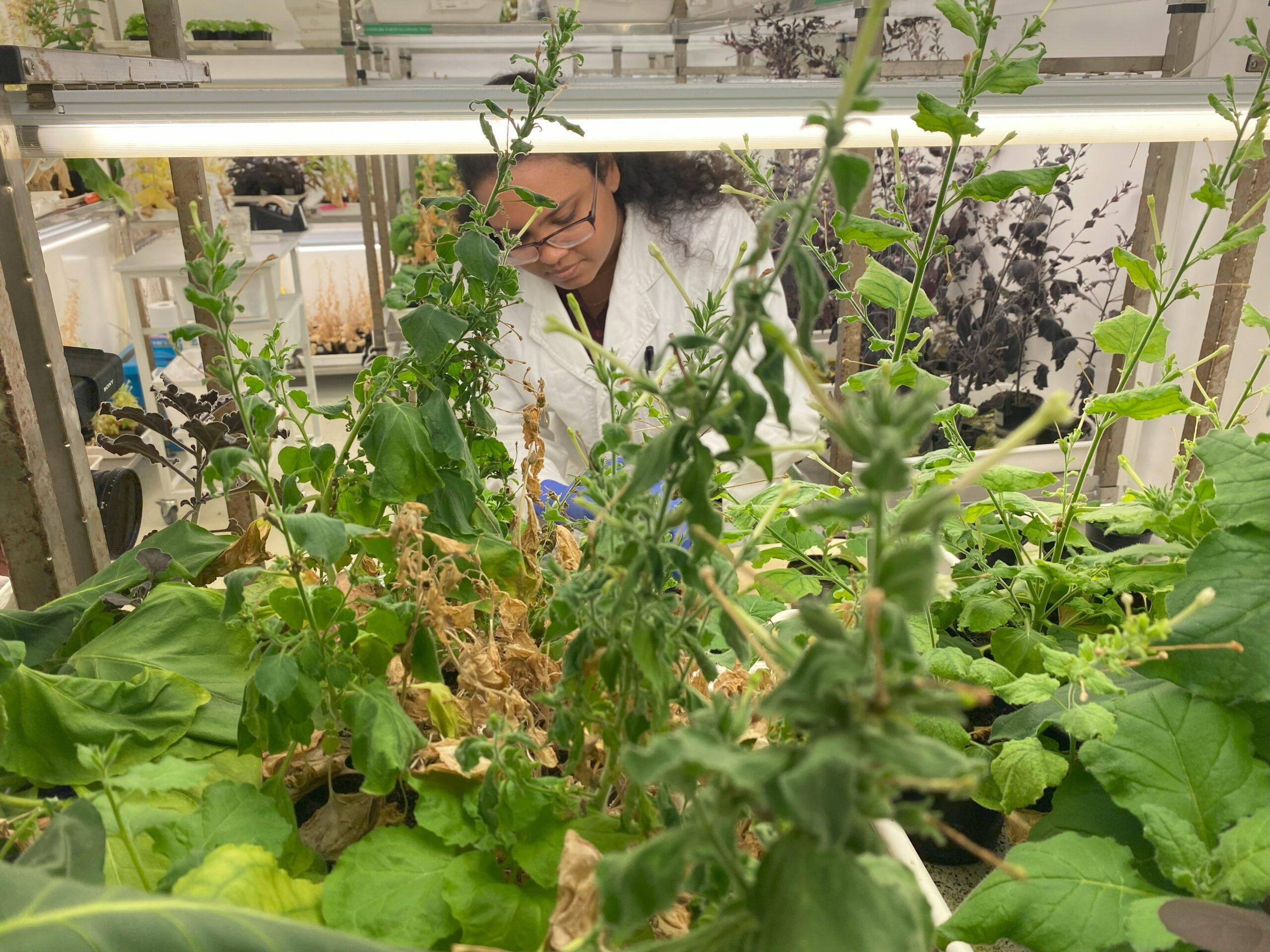
The laboratory strain of Nicotiana benthamiana, a native Australian plant, has been extensively used for the last two decades in plant research around the world. It has an almost unique ability to rapidly express foreign genes in its leaves after simple injection of a bacterium, carrying the foreign DNA. The Waterhouse group has been pioneering an understanding of the species’ origin, genome, epigenome, metabolome and ecological diversity. This has generated not only global genomic resources for fundamental research and biotechnology but also an appreciation of the species’ unusual evolution and the wealth of biological traits possessed by its different ecotypes.
The group has led international collaboration to provide data and web-based platforms that allow researchers to easily search and analyse the species at the genomic (Ranawaka, 2023), epigenomic (Ranawaka, 2024) and transcriptomic (Kurotani, 2025) level. These tools provide detailed, interactive platforms to search the plant’s ‘instruction manual’, further enhancing N. benthamiana as a global model, and providing the blueprints for genome editing in this species.
Having discovered the Central Australian origin of the laboratory strain and having collected a range of N. benthamiana accessions from Western Australia to Queensland and sequenced their genomes to provide resources for genome editing; the researchers have also examined the spectrum of traits possessed by the species. This led to the discovery that different accessions have evolved different strategies to survive drought (Asadyar, 2025). Some ecotypes adopt a rapid life cycle and remain relatively unresponsive to water loss while others slow down their growth and take actions to protect themselves. The insights from this work allow us to learn from nature how to combat climate stress and how such strategies might be translated into crops. The description of this research resulted in the ECR first author of the paper being nominated by the editor of New Phytologist for an international award.
Another ecotype-related finding was that unlike the laboratory strain, a Queensland accession has resistance to tomato yellow leaf curl virus (TYLCV), a major threat to tomato crops globally (Hayashi, 2024). A single gene appears to be responsible, but it differs from the candidates predicted from other related species. Current research in the Waterhouse lab, enabled by their chromosome-level genome sequence assemblies of laboratory and wild accessions of N. benthamiana, has developed a rapid mapping pipeline to identify trait-conferring genes. This pipeline is being used to identify the TYLCV resistance gene; understanding how it works may provide new avenues for crop protection.
These N. benthamiana studies are shining a light into some of the big challenges in plant science, from understanding complex genomes to surviving extreme weather and fighting plant diseases. Now that we know some of the parameters and have the technology to find, explore and edit the genes responsible, the next challenge will be to translate them, their traits and the strategies into crop species.
References
Asadyar, L. et al. (2024). Evidence for within-species transition between drought response strategies in Nicotiana benthamiana. New phytologist.
Hayashi, S. et al. (2024). Exploring the source of TYLCV resistance in Nicotiana benthamiana. Frontiers in plant science.
Kurotani, K. et al. (2024). Establishing a comprehensive web-based analysis platform for Nicotiana benthamiana genome and transcriptome. The Plant Journal.
Ranawaka, B. et al. (2023). A multi-omic Nicotiana benthamiana resource for fundamental research and biotechnology. Nature Plants.
Ranawaka, B. et al. (2024). Author Correction: A multi-omic Nicotiana benthamiana resource for fundamental research and biotechnology. Nature Plants.


