
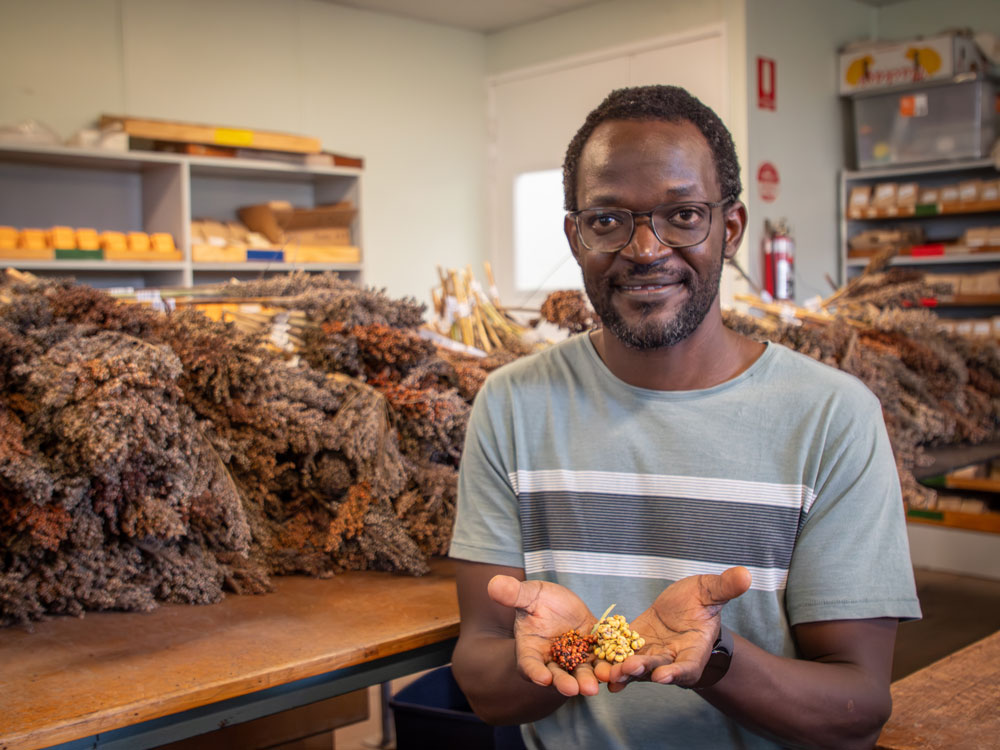
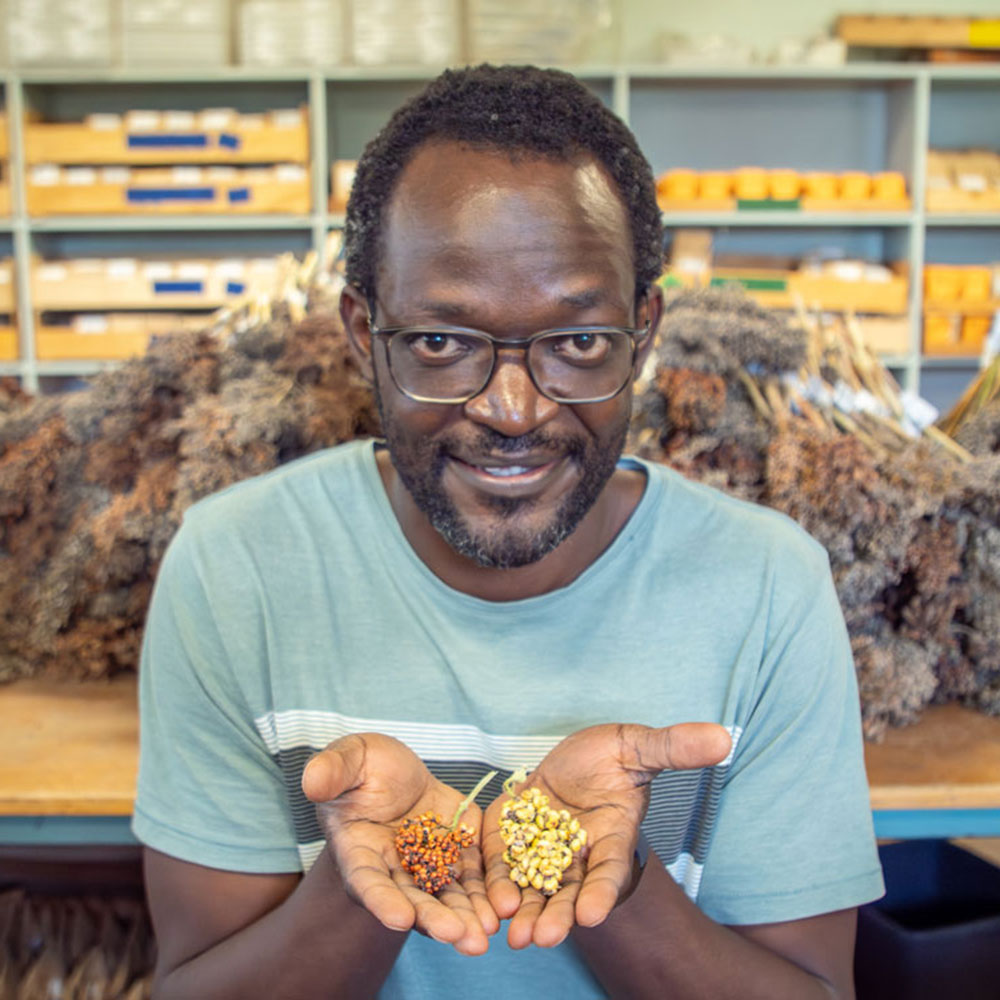
PhD candidate Daniel Otwani. Image: Megan Pope
A University of Queensland project is closing in on ways to increase the grain size in sorghum hybrids to boost yield and profits for farmers.
PhD candidate Daniel Otwani from the Queensland Alliance for Agriculture and Food Innovation and the ARC Centre of Excellence for Plant Success is analysing the diversity available within the sorghum germplasm to better understand the crop’s grain filling duration, the period between flowering and physiological maturity.
“Previous research has proven that varieties with high grain filling duration also have bigger grains,” Mr Otwani said.
“We are trying to improve the grain size of commercial hybrids, so understanding the differences in grain filling duration gives us the opportunity to improve those traits in sorghum breeding programs.
“Current commercial hybrids being marketed and sold in Australia have a much smaller grain size than other genotypes.
“We want to find a way to make those hybrids bigger, and we are targeting one trait, the grain filling duration to help us do that.”
Mt Otwani is using crop simulation modelling to understand the variation of this trait across environments.
He said grain size was extremely important for sorghum growers in Australia.
“Growers are paid for the yield they harvest from their crops but also for the size of the grain they produce.
“If they produce smaller grains then their sorghum may be downgraded, but if they have bigger grains, then they are paid more for that bigger grain.”
But climatic conditions in Australia add another complication.
“Yield here is affected for example by water, because if water is limited at the end of the grain filling period, then the chances are that farmers will get smaller grains,” Mr Otwani said.
“If you have varieties that are plastic in terms of water utilisation, then they can extend this grain filling duration when water is available and be guaranteed bigger grains.
“We have shown in our studies that increasing the grain filling duration by either 10 or 20 per cent guarantees an increase of between 3 and 7 per cent in terms of yield and grain size.
“The results we are getting are quite positive.”
Images are available via Dropbox.
Media: Daniel Otwani, d.otwani@uq.edu.au; QAAFI Media, Natalie MacGregor, n.macgregor@uq.edu.au, +61 409 135 651.


