
It was a very busy National Science Week for the Centre! Researchers from the University of Tasmania were at the Beaker Street Festival as Roving Scientists and working with high school art students at CoLab. Researchers also gave demonstrations as part of the Young Tassie Scientists Road Trips, and invited attendees at the Festival of Bright Ideas to become Plant Detectives!
At The University of Queensland, Centre members gave a career talk to 120 year 10 students, and a presentation about how AI and computational technologies are transforming crop science to 170 school teachers!
We also released our ‘cool jobs’ video series on YouTube, highlighting some of the diverse career opportunities available in STEM.
Young Tassie Scientists (pictured above)
PhD candidates Kritika Sharma and Jiacan Sun visited seven primary schools in Circular Head and also participated in the Circular Head Science Gig in Smithton. During the sessions, Kritika talked about the plant vascular system and used paper microscopes and optical dendrometers for demonstrations. Jiacan focused on the topic of symbiosis, introducing concepts such as nodulation, genes, and mutants, and demonstrated the differences between wild type and mutant. Jiacan said the trip was very rewarding, “I stepped out of my comfort zone and improved my own skills. It was a truly meaningful experience, and I greatly enjoyed sharing science with the young generation.”
 Beaker Street Festival
PhD candidates Chris McCarthy, Fergus Smith, Hanh Vo (pictured left), Joe Thomas, Katya Bandow, and Lily Bennett, along with Postdoctoral Researcher Ben Halliwell, volunteered as roving scientists at the Beaker Street Festival. Esmat Sarafraz and Katya Bandow also participated in CoLab.
 Festival of Bright Ideas
PhD candidates Kritika Sharma, Katya Bandow, Shamsunnahar Mukta and Hahn Vo ran the ‘Plant Detectives’ stall at the 2025 Festival of Bright Ideas event on Friday 22 (Schools Day) and Saturday 23 August (General Public).
The stall invited attendees to learn about what adaptions or traits have evolved to help some plants survive extreme environments. Conditions such as heat, drought, cold and flood are factors impacting plants more frequently due to climate change.
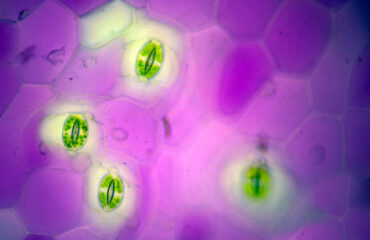
A popular activity for the science-curious was to look at traits inside plants using paper Foldscope microscopes, developed in the USA. One such close-up view highlighted the structure of aerial mangrove roots that have evolved to have large air channels in their tissue known as ‘aerenchyma’, which allows the plant to transport oxygen in waterlogged conditions – a desirable trait for flooding or rising sea levels.
Science Educators Colloquium
PhD Candidate Burhan Ud Din Abbasi gave a talk to 170 Primary and Secondary School Teachers exploring how artificial intelligence (AI) and computational technologies are transforming the landscape of crop science. The presentation delved into applications of computing technologies, i.e. machine learning, computer vision, and data analytics in different areas of agriculture. From predicting optimal breeding strategies to detecting plant diseases in real-time and modelling environmental interactions, we will discuss how technology is enabling faster, smarter, and more targeted crop improvement.
Career talk
Outreach Officer Chris Wacker visited Mabel Park State High School to give a presentation on careers in STEM to approximately 120 year 10 students. Chris talked to students about the various careers available in STEM and her own experience.